
Alberta LIVING WAGE REPORT 2025
A living wage approximates the hourly wage a worker needs to earn to cover their basic expenses and participate in their community.
Surprising Truths Hiding in Alberta's Living Wage Calculations
BEYOND THE MINIMUM
Most of us know the provincial minimum wage—the familiar legal floor below which wages cannot fall. But what does it actually cost to live a decent life in a specific Alberta community?
This is the question answered by the "living wage," a figure calculated to cover what a person needs to earn to meet their basic needs, participate in their community, and handle unexpected expenses.
The latest report from the Alberta Living Wage Network provides these crucial numbers for cities and towns across the province. But a look "under the hood" of these calculations reveals several counter-intuitive factors that dramatically influence what it truly costs to live in Alberta today.
KEY NUMBERS FOR EDMONTON
Here are some key numbers for Edmonton, based on a family of four, for 2025.
$83,510
Annually
$15,299
Food
$22,676
Shelter
$2,248
Clothing
$8,120
Transportation
$3,895
Healthcare
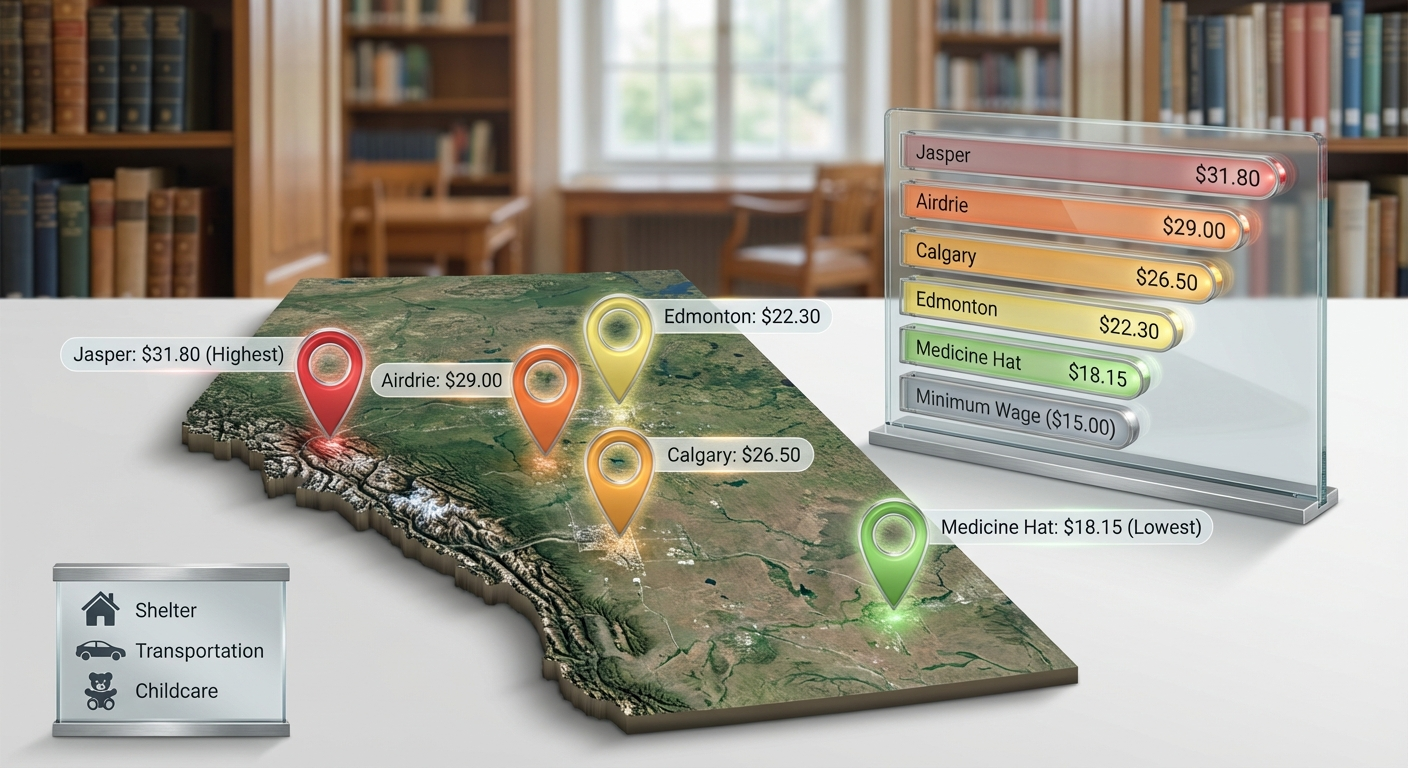
The calculated Living Wage rate for Edmonton is $22.30. The raw hourly wage required to cover expenses for a family of four is $20.92, while for a lone parent, it is $30.12, and for a single individual, it is $22.36.
OVERVIEW
The living wage is the hourly rate an individual must earn to cover basic expenses and participate in their community. It is calculated annually by the Alberta Living Wage Network (ALWN) for specific communities, reflecting local costs of living, and is distinct from the provincially mandated minimum wage.
In 2025, living wage rates across Alberta have been significantly influenced by three primary factors.
- First, a provincial change to the child care funding model for toddlers has resulted in higher costs for families in 15 of the 21 communities analyzed.
- Second, shelter costs have shown extreme volatility, with drastic rent increases in some municipalities driving wages up.
- Third, transportation expenses have risen in most communities, a consequence of updated calculation methodologies, higher assumed vehicle mileage reflecting post-pandemic realities, increased insurance rates, and more conservative financing assumptions for lower-income individuals.
.
The detailed analysis that follows breaks down these drivers, outlines the comprehensive methodology behind the calculations, and presents the 2025 living wage for 21 Alberta communities. A living wage is a community-specific calculation that approximates the hourly income a worker needs to earn to meet their basic needs while working full time (35 hours per week). Unlike the legislated minimum wage, which is uniform across the province, the living wage accounts for the variable costs of living in different communities.
The calculation encompasses essential expenses such as food, clothing, shelter, child care, and transportation. It also incorporates modest provisions for community participation, continuing education, and a contingency fund for unexpected costs. The rate is recalculated each year by ALWN to reflect changes in living costs and public policy that impact affordability.
Analysis of the 2025 data reveals that shifts in child care, shelter, and transportation costs had the most substantial effects on living wage rates across Alberta.
Key Factors Influencing 2025 Living Wage Rates
Child Care Costs
A significant driver of change was the provincial government's new child care funding model for toddlers, which took effect in April 2025. This model replaced the previous system of affordability grants and income-tested subsidies with a flat parent fee of $326.25 per month, plus optional supplemental fees for services like food and field trips.
For most families at the living wage income level, this change has increased their net child care costs. The analysis indicates that in 15 of the 21 communities, families are financially worse off under this new program.
Shelter Costs
Shelter costs demonstrated significant volatility, with average rental rates increasing drastically in some communities while decreasing in others. These fluctuations had a direct and powerful impact on the local living wage.
Transportation Costs
Transportation costs rose in most communities due to a combination of methodological updates in the primary calculation tool (CAA's Driving Costs Calculator) and real-world cost increases.
Overview of Calculation Methodology
The living wage calculation is guided by a standardized methodology developed by ALWN members and its economist. A custom calculator programmed by Puzzle Rock Coding uses algorithms to determine the wages needed to cover expenses after accounting for taxes and government benefits.
Household Model
The final living wage for each community is a weighted average based on the income needs of three distinct household types. The weighting reflects their prevalence in Alberta according to the 2021 census data.
Expense Categories and Data Sources
The calculation is built upon a comprehensive budget covering all major household expenses.